Media highlights about our launch

Some highlights of news coverage of the Open Humans launch:

We also had press in Reuters, Boston Globe / BetaBoston, Nature, Geek.com, HealthIT Security, Popular Science, the Daily Free Press, the Scientist, Scientific American, PM Live, the Knight Foundation blog [1] [2], the Stack, Geek, Fortune, and RT News.

We’re honored by the tremendous positive response to our launch!

Open Humans – website updates and improvements

We’ve had a wonderful response to our launch two weeks ago – as of today, over 1,000 people have signed up as members of this new community!

We’ll always be working hard to expand and improve the site. Here’s our first batch to report, post-launch.

A “Welcome” guide for new users
One thing our site really needed was a guide for new members! We’ve added some Welcome pages to help people get started with first steps.

Click here to see our tips for getting started on Open Humans.

Improved login
We also improved our login process: Now you can log in with your username or your email address. If you had trouble logging in before, we hope this makes it much easier!

Data sources survey
One of our new welcome pages is actually a survey. Do you have data sources (e.g. 23andMe, FitBit, RunKeeper) that you’re interested in donating to research?

Although we can’t build everything at once, it’s important for us to know which data sources represent the highest value for our community – if you’re a member, we’d love to hear from you.

To contribute, please go to our site to fill out the survey.

We’re continuing to work hard to improve the website, as well as finding new studies and opportunities to import and receive data. Thank you for your participation and willingness to open-source your body!

News Release: How to donate your body to science, without having to die: Launch of Open Humans Network

“Open Humans” project backed by Knight and Robert Wood Johnson Foundation invites individuals to share their most personal health information to accelerate medical breakthroughs.

Note: embeddable videos, photos and graphics are available at www.supportmedia.org/openhumans

BOSTON (March 24, 2015) A group of top university scientists just launched a project to build a community of researchers and participants who want to benefit medical progress – by using technology to open up health data.

The “Open Humans Network,” created by researchers from Harvard, New York University and the University of California San Diego, is backed by a $1 million investment from the John S. and James L. Knight Foundation and the Robert Wood Johnson Foundation, each of which contributed $500,000 in separate grants.

The project aims to break down barriers that make it difficult for willing individuals to access and share their data with researchers. To this end, the Open Humans Network creates an online system that helps match people who want to share their health data with researchers who would benefit from access to more information.

“Think of it as open-sourcing your body,” says the project’s director, Jason Bobe who also runs the project’s parent organization, PersonalGenomes.org. “There is tremendous potential for accelerating medical discoveries by helping individuals take their health and personal data out of data silos and making the data more broadly used.”

The Open Humans Network hopes to accelerate scientific discoveries by making far more data available. The premise is that more individuals will join scientific studies if they are empowered with the choice to share their data. And the greater availability of shared data will allow scientists to conduct more studies, and produce more robust and meaningful results.

Researchers increasingly face problems in recruiting individuals to participate in studies. Participation rates in the US have been dropping, according to a 2011 report by researchers at Wayne State University School of Medicine.

Researchers can join the Open Humans Network at openhumans.org by adding their studies to the network’s data-sharing framework. Individuals can join and participate in studies that are part of the framework by importing their data into a profile on the Open Humans Network website.

At launch, the site invites members to join three studies:

  • “American Gut” – exploring microbial diversity of the human body;
  • “GoViral” – profiling viruses related to flu-like illness; and
  • “Harvard Personal Genome Project” – collecting genomic, environmental and human trait data.

With shared data from these studies, researchers hope to glean new insights only possible after combining the data, for instance, whether a person’s gut microbiome influences susceptibility to the flu.

The founders plan to add other health data-related services like RunKeeper.

The project does not treat the sharing of private information lightly. Individuals who want to publicly share their data have to pass a test as part of the consent process to demonstrate that they understand the potential risks of sharing personal health data, such as discrimination or embarrassment.

“We strongly care about the impact of sharing, which is why the project has a research component, including an ethics review board, to study the outcomes of such personal health data disclosure,” said Madeleine Ball, the project’s lead investigator. “Despite the risks, we find many people genuinely want to ‘open source’ themselves to contribute to the greater good.”

“Open Humans is one of the leaders among a new group of platforms that aim to change the way scientific discovery is made,” said Paul Tarini, senior program officer at the Robert Wood Johnson Foundation. “We see their efforts to foster more collaboration between participants and researchers, including making it easier for participants to share data and to comment on early research concepts as important steps to help advance and accelerate medical breakthroughs.”

Open Humans Network was a winner of the Knight News Challenge on Health, which focuses on using news and data to engage communities.

“Making data more open and accessible is essential to building more informed communities,” said John Bracken, Knight Foundation’s vice president for media innovation. “Open Humans Network answers that call, leveraging new technologies to unlock health data so that people can better make decisions on issues that are important to them.”

Ball emphasized that the project’s founders hope to reach people with a passion for science. “For individuals who care deeply about helping advance science and medicine, informed and responsible sharing of their personal health data is an important and meaningful option to benefit society,” she said.

As one participant put it: “It’s like donating your body to science, without having to die.”

To register a study, enlist in research, apply here for more information, visit http://www.openhumans.org.

About the Robert Wood Johnson Foundation: 
For more than 40 years the Robert Wood Johnson Foundation has worked to improve health and health care. We are striving to build a national Culture of Health that will enable all to live longer, healthier lives now and for generations to come. For more information, visit http://www.rwjf.org. Follow the Foundation on Twitter at http://www.rwjf.org/twitter or on Facebook at http://www.rwjf.org/facebook.

About Knight Foundation:
Knight Foundation supports transformational ideas that promote quality journalism, advance media innovation, engage communities and foster the arts. The foundation believes that democracy thrives when people and communities are informed and engaged.

About PersonalGenomes.org
PersonalGenomes.org is a charitable organization working to generate, aggregate and interpret human biological and trait data on an unprecedented scale. Its mission is to make a wide spectrum of data about humans accessible to increase biological literacy and improve human health. The nonprofit’s efforts are informed by values encouraging greater transparency and collaboration between researchers and participants. Its programs include Open Humans, Personal Genome Project and the annual GET Conference.
Highlights from the Network, February 2015

Through our collaborations and programs like the GET Conference, Personal Genome Project, & Open Humans, we have the good fortune of interacting with a lot of people doing incredible things in the world.  So we are continuing with our series that will keep track of noteworthy articles and media featuring individuals in our broad network.  Here is a selection of recent highlights. We hope you enjoy it:


What We’re Reading

A list of things from around the web that we’re reading. Hope you enjoy!

Who Should Have Access to Your DNA? Medium

UW Study Finds Returning Incidental Findings May be Cost Effective. Genome Web

Topol: Why Are Doctors and Hospitals the Owners of Patient Records? Medscape

Teen identifies rare mutation in her own cancer, champions new age of open-access genetics. Genetic Literacy Project

Biology, Computing, and the History of Molecular Sequencing: From Proteins to DNA, 1945–2000.

Discrimination based on genetics could soon be illegal, and it’s right on time. Canada.com

The First Amendment Right to Speak about the Human Genome. Social Science Research Network

Trust me, I’m a medical researcher. Science Magazine

Every Patient a Subject: When personalized medicine, genomic research, and privacy collide. Slate

Small company offering direct-to-consumer whole genomes for just $1850 Facebook post (related to the New product for 2015: sub-$2000 whole-genome sequencing announcement from Full Genomes).

Highlights from the Network, December 2014 and January 2015

Through our collaborations and programs like the GET Conference, Personal Genome Project, & Open Humans, we have the good fortune of interacting with a lot of people doing incredible things in the world.  So, we are starting a new series that will keep track of noteworthy articles and media featuring individuals in our broad network.  Here is a selection of recent highlights, we hope you enjoy it:

Highlights from the Network, November 2014

Through our collaborations and programs like the GET Conference, Personal Genome Project, & Open Humans, we have the good fortune of interacting with a lot of people doing incredible things in the world.  So, we are starting a new series that will keep track of noteworthy articles and media featuring individuals in our broad network.  Here is a selection of highlights, we hope you enjoy it:


Now Hiring: Back-end Web Developer

Help spread the word! We’re seeking a Senior Software Engineer at PersonalGenomes.org to work on the Open Humans Network, a project that aims to help people aggregate and share their health and trait data to advance scientific, educational and humanitarian causes.

Our model for this initiative is the work we’ve done on the Harvard Personal Genome Project (PGP), which has over 3,000 volunteers publicly sharing extensive biological and trait data, including hundreds of whole genomes, exomes, and genotyping data sets, over 1,000 health records, microbiome datasets from various bodily habitats, device data, brain imaging, etc. This combination of a highly informed and engaged community of volunteers and their contributions of extremely rich biological and health data, along with a network of collaboration-minded researchers, is an incredibly powerful scientific and educational resource that is unrivaled elsewhere. We will build on this momentum with this exciting new initiative that will transform participatory research and advance human health. Check out our recent blog post to see news coverage, videos, and learn more about Open Humans.

Our current hiring position is focusing on someone with back-end web development skills, as we have plans to work with a design firm for initial front-end work. Because we plan to develop open source software used by researchers, we believe Python (which many scientists use) is generally preferred.

We’re looking for someone who…

  • Is interested in building and managing a full-stack website. As the Senior Software Engineer, your expertise will be an important factor in decisions about what kind of technology is used and how it’s deployed.
  • Has used multiple programming languages to build production systems (e.g. Python, JavaScript, Ruby).
  • Is experienced with back-end web development (e.g. Rails or Django).
  • Is comfortable managing Unix servers, cloud-based services and has opinions about how to store and disseminate large datasets (currently around 50TB total, although we would start with managing <10GB).
  • Works well in a small team of developers and scientists.
  • Loves science, participatory research, and free/open source ideals.
  • Believes in our mission!

About PersonalGenomes.org
PersonalGenomes.org is a 501(c)(3) nonprofit organization working to generate, aggregate and interpret human biological and trait data on an unprecedented scale. PersonalGenomes.org’s mission is to make a wide spectrum of data about humans accessible to increase biological literacy and improve human health. Its efforts are informed by values encouraging greater transparency and collaboration between researchers and participants. The organization supports the Personal Genome Project (PGP) global network. The first PGP research study was founded at Harvard Medical School in 2005, and PGP sites now exist at leading institutions in four countries. We also produce the annual Genomes, Environments and Traits (GET) Conference.

About Open Humans
We have years of practical experience, thousands of participants, and diverse data sets accrued. What we need now is an experienced developer to help us build a site for participants and researchers to manage and publicly share this data. Think of this as a nonprofit startup project!

Location
We strongly prefer for the software engineer to be based in Boston, Massachusetts. We can be flexible on geography with the right person, and might also be interested in engineers based in New York City. We collaborate with people all over the globe.

Your experience
In addition to your resume or CV, please feel free to share any open source projects, side projects, and development experiences you are proud of.

Compensation
We offer a competitive salary, commensurate with experience.

Contact
Jason Bobe, jason@personalgenomes.org
Madeleine Price Ball, madeleine@personalgenomes.org

What is Open Humans?

What is Open Humans? Open Humans is about science, sharing, and community. To kick off our blog, we’d like to open with some links to various media about Open Humans from the past couple months.

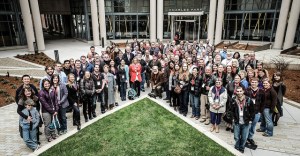
Personal Genome Project Participants at GET Labs. Aurelien Dailly for PersonalGenomes.org, CC-BY.

New platforms aim to obliterate silos of participatory science

(Article) GET Labs and Open Humans are discussed in this article by Elie Dogen at Nature Medicine News, including some quotes from Jason and the context of GET Labs. Also some quotes from researchers we plan to work with at American Gut and Flu Near You (Daniel McDonald and Rumi Chunara).

By opensource.com, CC BY-SA license.

Some patients are eager to share their personal data

(Article) An interview of Madeleine by Shauna Gordon-McKeon, posted at opensource.com. Madeleine gives some background on motivation for the project, reflecting on lessons learned by the Personal Genome Project at Harvard.

2014bitsbiology_screenshotOpen Data, Open Humans

(Video, 9 min) Madeleine’s talk about Open Humans at the Bits ↔ Biology meeting at MIT. Human research generates identifiable data, creating a tension between privacy and data sharing. Participant-mediated data sharing has the potential to unlock that data and transform how we research ourselves.

From Volunteers, a DNA Database

(Article) In April, the New York Times Science Section featured GET Labs, the Personal Genome Project, and other Open Humans collaborators. Quotes from Jason, Open Humans adviser Abigail Wark, and participant Beau Gunderson.

screenshot_QSPHS-2014_Jason-talkParticipant Centered Research Design

(Video, 10 min) Jason discusses the concept of “participant-centeredness” at the Quantified Self Public Health Symposium at the Qualcomm Institute at UCSD.